
My niece recently injured her knee, so Uncle Brickhouse came to the rescue with a rehab plan, but not everyone has a smart, handsome, all around awesome uncle like me. I thought to myself, why not write something that could help clear up why knee injuries happen in women way more than men (about 3x the amount) and help a ton of people at the same time.
If you’ve coached long enough, or been around sports long enough, you’ve seen it:
A girl plants to cut.
The knee caves.
Non-contact injury.
ACL injury.
This is the most common injury that female athletes deal with, but why? Why do women have a 3 x higher knee injury rate than men?
Let’s talk.
First — Why Does This Happen?
There isn’t one reason.
1) Structure Matters
Women generally have a wider pelvis. This creates a bigger Q-angle (the angle from hip to knee). “What the hell does that mean coach?” Bear with me. I promise it will make sense.
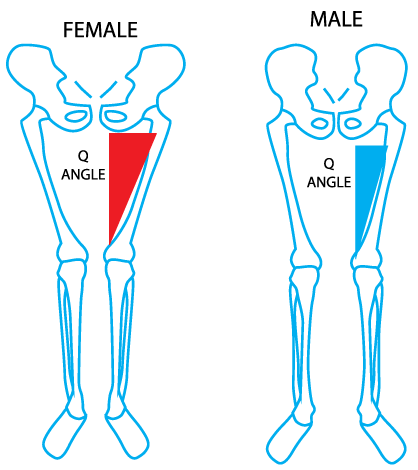
More tendency for the knee to drift inward. …(See, told you I’d make it simple.)
When that inward collapse (valgus) happens under speed, load, or fatigue… the ACL takes the hit.
But that’s not the only structural factor.
Studies have shown that women often have a narrower intercondylar notch — that’s the groove at the bottom of the femur where the ACL sits and passes through.
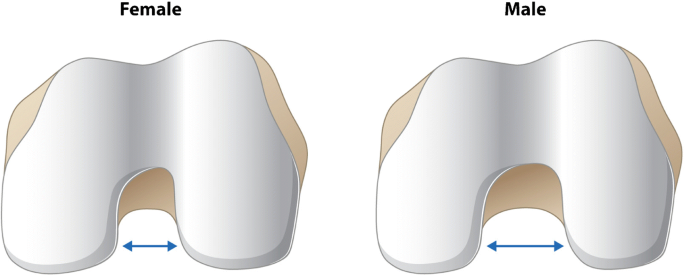
Think of it like this:
The ACL lives inside that notch.
If the notch is narrower, there’s simply less room for the ligament to move freely.
During high-speed pivoting, cutting, or twisting, that reduced space may increase the chance of the ACL getting impinged (pinched) or placed under higher stress. Over time — or under one bad rep — that can contribute to tearing.
Again — this isn’t a weakness.
It’s anatomy.
And anatomy just means we program smarter.
2) Hormones Play a Role
Estrogen fluctuates throughout the menstrual cycle. Higher estrogen phases can increase ligament laxity slightly.
That doesn’t mean “you’re fragile.”
It means passive stability might be a little lower at certain times.
If the muscles around the knee aren’t strong and reactive enough to compensate, that’s where problems happen.
So when you hear me or other coaches saying that strength training is for everyone. We mean EVERYONE!
3) Quad Dominance Is Real
A lot of women are naturally more quad-dominant.This is partially due to the increased (Q-angle) we talked about earlier. Increased angle = more quad involvement to help with stability. Weird right!
It will look like:
- Strong knee extension
- Less hamstring contribution
- Less aggressive hip drive
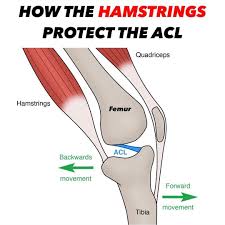
The ACL’s job is to stop the shin from sliding forward.
The hamstrings help with this as well. So If the hamstrings aren’t firing hard enough, the ACL works overtime. Make sense?
4) Landing Mechanics
Watch slow motion clips of women’s basketball or soccer.
You’ll often see:
- Upright torso
- Minimal hip hinge
- Knees collapsing inward
- Stiff landings
That’s a recipe for anterior tibial translation (shin sliding forward). And that’s the exact mechanism for ACL tears.
Most Common Knee Issues I See
ACL Tears
Big one. Usually non-contact. Plant and cut injuries.
Patellofemoral Pain (Runner’s Knee)
Front of knee pain. Very common in lifters and runners. Anyone that is very quad dominant.
Meniscus Tears
Often paired with ACL injuries or deep twisting.
IT Band Syndrome
Lateral knee pain from poor hip control.
So How Do We Prevent This?
- Strengthen posterior chain
- Strengthen hips (especially external rotators)
- Strengthen the hamstrings. I’ll say it louder for those in the back with bad eye sight. TRAIN THE HAMSTRINGS!
- Train deceleration and landing mechanics
Sounds simple but you’d be surprised how often these small things get overlooked. Especially by strength and conditioning coaches that run multiple programs at a college level.
Strength Template (Injury Prevention Focus)
This is a basic template. You can tailor this to your needs. Add more hamstring work or be more sport specific but no matter what, talk to your doctor before doing anything. Nothing in this article is medical advice. It’s simply stuff I have learned dealing with clients over the past 20 years that have come to me with pain and still want to compete.
Day A – Stability & Strength 2–3x per week.
- Trap Bar Deadlift – 4×5
- Rear Foot Elevated Split Squat – 3×8/side
- Romanian Deadlift – 3×8
- Lateral Band Walks – 3×15 steps each way
- Copenhagen Plank – 3×20 sec/side
- Tibialis Raises – 3×15
Focus: own every rep. No knee collapse.
Day B – Control & Deceleration
- Box Squat (3 sec down) – 4×6
- Single-Leg RDL – 3×8/side
- Step-Downs (slow) – 3×10/side
- Nordic, GHR or Machine Hamstring Curl – 3×8–10
- Pallof Press – 3×12
- Stick Landings (small box, hold landing) – 3×5
You’re teaching your body how to absorb force.
That’s protection.
Rehab Template (ACL / Front Knee Pain Focus)
Obviously this depends on where someone is in recovery — but here’s a general progression.
Phase 1 – Calm It Down & Activate
- Quad Sets – 3×15
- Straight Leg Raises – 3×12
- Terminal Knee Extensions – 3×15
- Glute Bridges – 3×12
- Clamshells – 3×15
- Heel Slides – 3×15
Goal: Get quads firing, reduce pain, restore control.
Phase 2 – Controlled Strength
- Spanish Squats – 3×12
- Step-Ups (low box) with slow eccentric– 3×10/side
- Single-Leg Glute Bridge with holds at top– 3×10
- Seated Hamstring Curl – 3×12
- Leg Press (controlled) – 3×12
- Calf Raises – 3×15
- Tibialis raises- 3 x 15
Now we’re building real strength.
Phase 3 – Return to Power
- Trap Bar Deadlift – 4×5
- Bulgarian Split Squat – 3×8
- Nordic Hamstring Curl – 3×6
- Lateral Lunges – 3×8/side
- Low Box Jumps (soft landing) – 3×5
- Deceleration Drop Steps – 3×5
This is where we make the knee resilient again.
Here’s The Real Takeaway
Women aren’t “more fragile.”
They just need programming that respects their structure and neuromuscular tendencies.
Most ACL injuries are non-contact.
That means they’re often preventable.
Stronger hips.
Stronger hamstrings.
Better landing mechanics.
Smarter programming.
proper rest and nutrition
That’s it.
Want Knees That Actually Hold Up To Your Sport…
If you’re an athlete, lifter, or coach and you want:
- Stronger, more stable knees
- Better squats and deadlifts
- Faster cut speed on the field
- Less random knee pain
- Programming that actually makes sense
This is what I do.
I’ve spent 20+ years competing and coaching strength athletes. I don’t just write workouts — I build systems that keep you strong and healthy long term.
If you’re ready to train with intention instead of guessing…
Apply for coaching.
Let’s build strength that lasts.

0 Comments